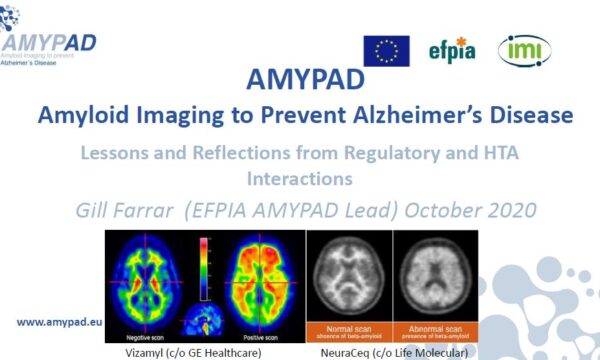
A new paper titled “Amyloid PET predicts atrophy in older adults without dementia: Results from the AMYPAD Prognostic & Natural History study” has been published in the journal NeuroImage: Clinical, aiming to determine the influence of global cortical amyloid burden on regional brain atrophy and further investigating how the relationship between Aβ and atrophy is influenced by sex and APOE-ε4 carriership, and the additive predictive value of utilizing longitudinal amyloid-PET data.
Abstract:
The impact of amyloid-β (Aβ) accumulation on regional brain atrophy in preclinical Alzheimer’s disease (AD), and its interaction with risk factors like sex and APOE-ε4 carriership, remains unclear. In this study, we examined these associations in a population of older adults without dementia and evaluated the potential of Aβ-PET for risk stratification.
We included 1329 participants (56 % female) with an age of 68.2 ± 8.78 years from the prospective multi-center AMYPAD Prognostic and Natural History Study who underwent [18F]Flutemetamol or [18F]Florbetaben Aβ-PET and T1-weighted MRI, with longitudinal data for 684 participants (median follow-up = 3.4 years). Linear mixed models assessed the effect of baseline Aβ burden through the Centiloid approach on longitudinal changes in regional gray matter volume and thickness. Sensitivity analyses were performed in cognitively normal only (CDR = 0) individuals and while correcting for CSF p-tau181 and t-tau. A second model investigated the effects of sex or APOE-ε4 carriership.
Baseline global Aβ was predictive of widespread atrophy in several brain regions, most strongly in the fusiform (βVolume = -0.006, βThickness = -0.009), hippocampus (βVolume = -0.005), posterior cingulate (βVolume = -0.006), and precuneus (βVolume = -0.004, βThickness = -0.007), also when investigating only in cognitively normal individuals. Only fusiform atrophy (βp-tau = -0.011; βt-tau = -0.011) remained predicted by Aβ when correcting for p-tau181 or t-tau. Temporal atrophy was exacerbated in women, while frontal, lateral-temporal and hippocampal atrophy was exacerbated by carriership of at least one APOE-ε4 allele, with volumetric loss more sensitive to sex effects and thinning more sensitive to APOE-ε4 effects.
Our findings suggest that in older adults with mostly preserved cognition, baseline Aβ-PET predicts future brain atrophy, with fusiform atrophy showing independence from tau pathology and Aβ-dependent atrophy being exacerbated in region-dependent manners in females and APOE-ε4 carriers. Regional cortical volume and thickness may serve as sensitive markers for early Aβ-related neurodegeneration and aid in stratifying risk in AD prevention trials.
Highlights:
- Aβ-PET predicts atrophy in key brain regions in older adults without dementia.
- Fusiform volumetric loss is linked to Aβ independent of CSF tau levels.
- Temporal atrophy is stronger in women with higher Aβ burden.
- APOE-ε4 carriers show larger Aβ-driven frontal & hippocampal atrophy.
You can download the paper here.
Congratulations to all authors: Leonard Pieperhoff, Luigi Lorenzini, Sophie Mastenbroek, Mario Tranfa, Mahnaz Shekari, Alle Meije Wink, Robin Wolz, Sylke Grootoonk, Craig Ritchie, Mercè Boada, Marta Marquié, Wiesje van der Flier, Rik Vandenberghe, Bernard J. Hanseeuw Pablo Martínez-Lage, Pierre Payoux, Pieter Jelle Visser, Michael Schöll, Giovanni B. Frisoni, Andrew Stephens, Christopher Buckley, Gill Farrar, Frank Jessen, Oriol Grau-Rivera, Juan Domingo Gispert, David Vállez García, Henk Mutsaerts, Frederik Barkhof, Lyduine E. Collij, on behalf of the AMYPAD consortium